

Key Takeaways
- FTA-Approved Accredited Service Providers are the only intermediaries legally authorised to validate and transmit e-invoices under the UAE's Electronic Invoicing System (EIS UAE).
- The UAE uses a 5-corner Decentralised Continuous Transaction Control and Exchange (DCTCE) model built on the Peppol network, with the FTA acting as the 5th corner.
- Pre-approved status allows pilot participation; fully accredited status is mandatory for production go-live from 1 January 2027.
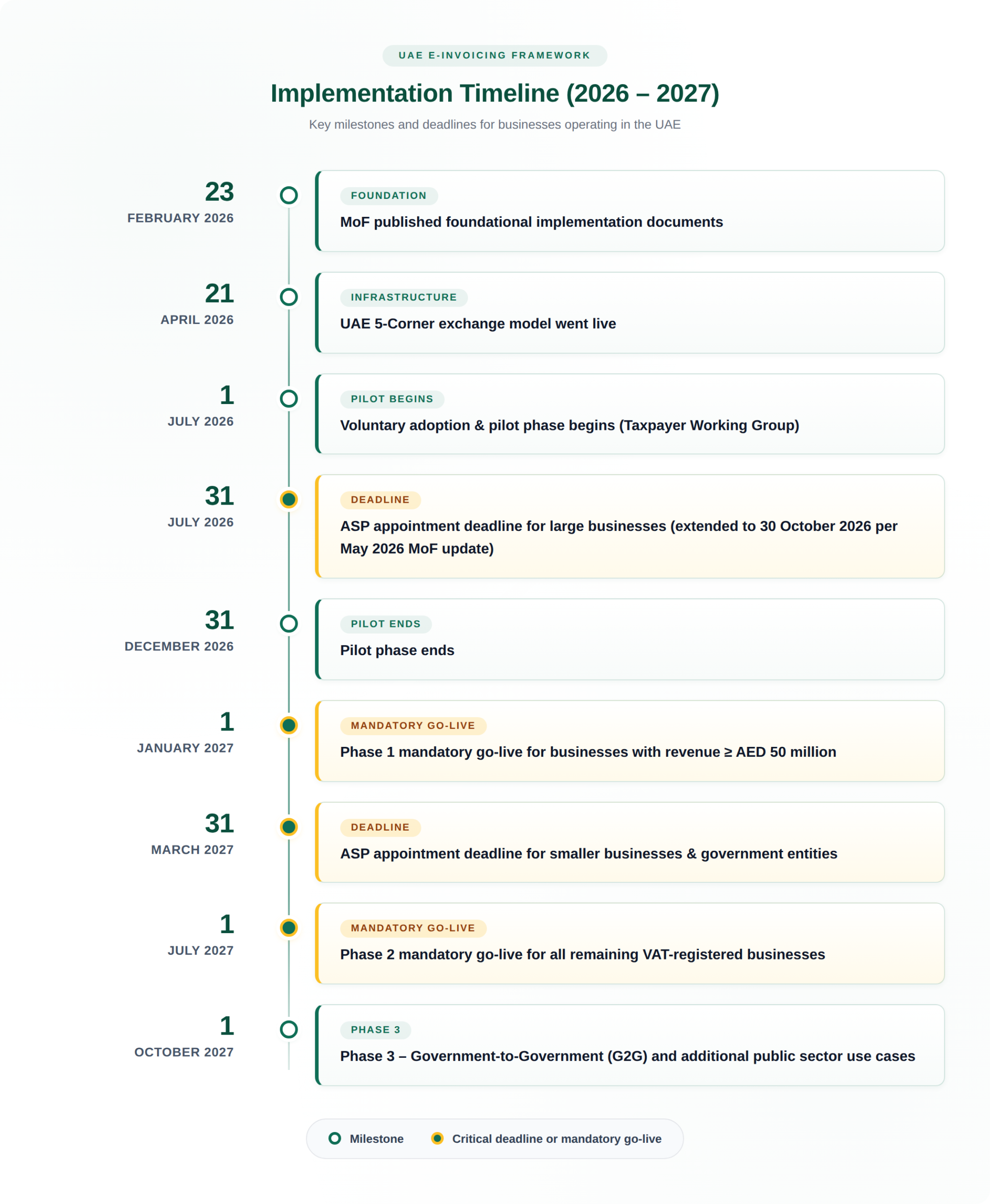
- Businesses with revenue ≥ AED 50 million must appoint an ASP by 31 July 2026 (extended to 30 October 2026), with mandatory go-live on 1 January 2027.
- Smaller VAT-registered businesses must be appointed by 31 March 2027, with go-live on 1 July 2027.
- Non-compliance triggers administrative fines of up to AED 5,000 per month and additional penalties per Cabinet Resolution No. 106 of 2025.
- The official list of pre-approved providers currently includes 20+ ASPs published by the Ministry of Finance, with the final accreditation list expected before key Phase 1 deadlines.
Understanding E-Invoicing in UAE
The UAE has moved from voluntary digital invoicing to a structured, regulated e-invoicing mandate that affects every VAT-registered business. Under the new UAE e-invoicing regulations, all B2B and B2G invoices must flow through an FTA-Approved Accredited Service Provider in the UAE, validated against the PINT AE schema, and reported to the Federal Tax Authority in near real-time.
For UAE businesses, this means traditional PDF invoices, scanned copies, and manual emails no longer count as compliant e-invoices. The entire electronic invoicing system in UAE is built on the globally trusted Peppol e-invoicing in UAE framework, ensuring interoperability across the GCC and international trade.
What Are FTA-Approved Accredited Service Providers in the UAE?
An FTA-Approved Accredited Service Provider (ASP) is an officially certified intermediary that businesses must use to issue, validate, and transmit structured electronic invoices under the UAE's e-invoicing framework. The accreditation is granted by the Ministry of Finance (MoF), and the invoices transmitted by these ASPs are reported to the Federal Tax Authority (FTA) for VAT and Corporate Tax compliance.
Key deadlines every finance team should have on their radar:
- Phase 1 - ASP Appointment Deadline: 30 October 2026 (extended from 31 July 2026 under Ministerial Decision No. 244 of 2025): Enterprises with annual revenues above AED 50 million. Note: the eInvoicing go-live timeline remains unchanged, only the ASP appointment milestone has shifted.
- Phase 2 (March 2027): Broader VAT-registered business population
- Recommended go-live lead time: Minimum 3 months before your applicable deadline, begin ASP evaluation now to avoid a compressed implementation window ahead of 30 October 2026.
What Is an FTA-Approved Accredited Service Provider (ASP)?
An FTA-Approved Accredited Service Provider (ASP) is an officially certified intermediary that businesses must use to issue, validate, and transmit structured electronic invoices under the UAE's e-invoicing framework. The accreditation is granted by the Ministry of Finance (MoF), and the invoices transmitted by these ASPs are reported to the Federal Tax Authority (FTA) for VAT and Corporate Tax compliance.
In the UAE's e-invoicing architecture, businesses cannot exchange e-invoices directly from one ERP system to another. Every invoice in scope must pass through a certified ASP, which:
- Validates the invoice against the PINT AE (Peppol International Invoice – UAE) XML schema
- Transmits the invoice to the buyer through the Peppol network
- Reports the structured tax data to the FTA in near real-time
- Provides confirmation receipts and maintains audit-grade records for the 5-year archival period mandated by Federal Decree-Law No. 8 of 2017
Put simply, an ASP is the regulated bridge between your billing system and the UAE tax ecosystem. Without one, your invoices have no legal validity under the new regime.
Why the UAE Adopted the ASP Model
The UAE deliberately chose a Decentralised Continuous Transaction Control and Exchange (DCTCE) model, often called the 5-corner Peppol model. Here is how an invoice flows under this architecture:
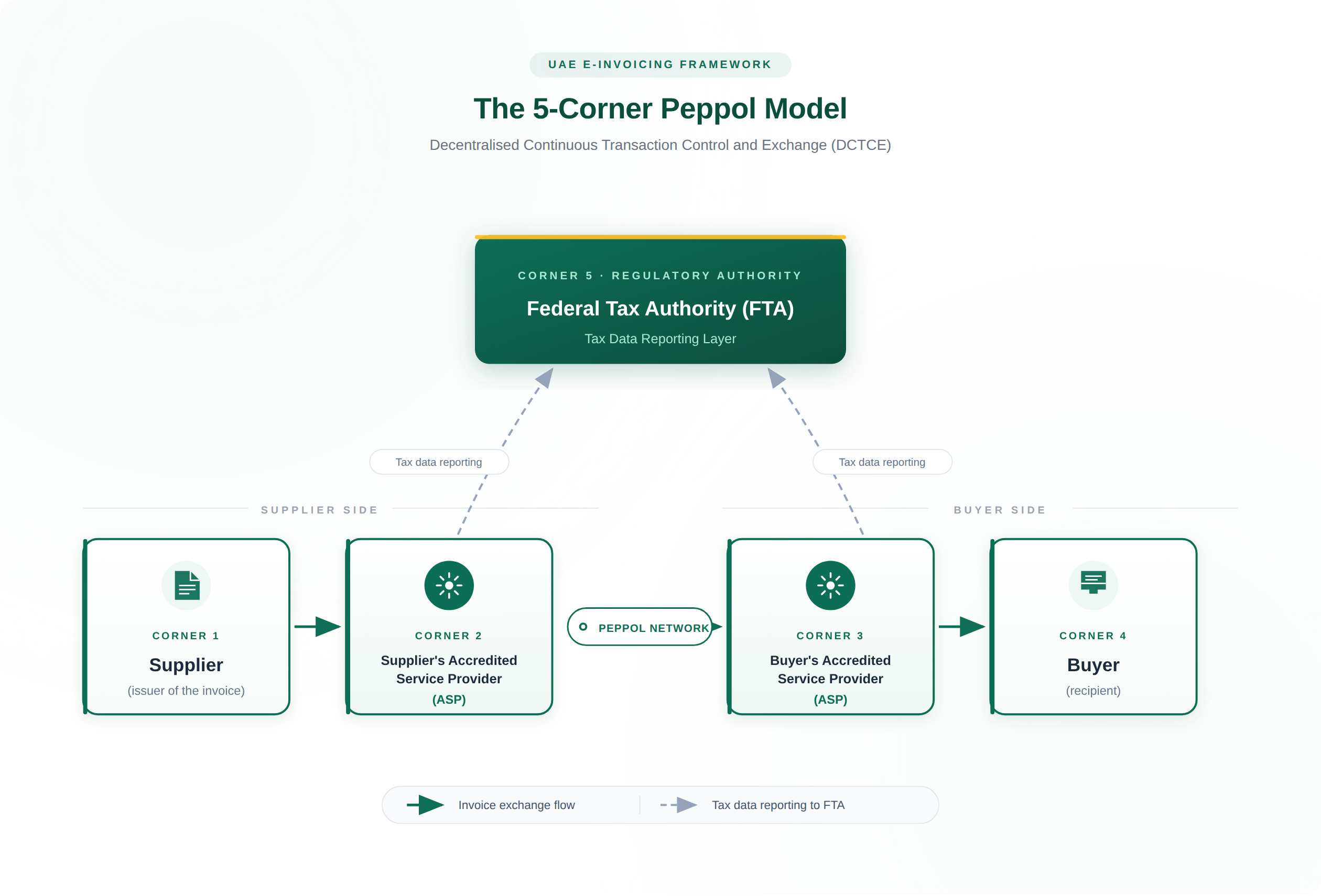
The Peppol Participant ID for every UAE business follows the format 0235: [10-digit TIN], derived from the first 10 digits of your TRN.
This design balances three priorities: it keeps invoice exchange decentralised (no government bottleneck), it ensures real-time tax visibility for the FTA, and it leverages the globally adopted Peppol standard for interoperability across GCC and international trade.
Pre-Approved vs Accredited Service Providers: The Critical Difference
In the UAE framework, Pre-Approved and Accredited are two distinct stages of the same approval pathway, and confusing them can derail your compliance plan.
Pre-Approved Service Provider
The provider has cleared initial eligibility and technical readiness checks by the Ministry of Finance. They can:
- Participate in controlled onboarding and validation activities
- Support businesses during the July 2026 pilot phase
- Run sandbox testing and pilot transmissions
- Prepare ERP integrations and field mapping
However, pre-approval is not a substitute for full accreditation. Providers must progress to accredited status within the MoF-defined timeline.
Accredited Service Provider (ASP)
The provider has completed the full compliance pathway, including advanced technical testing, security audits, and operational readiness reviews. Accredited ASPs are authorised for:
- Production-grade invoice validation and transmission
- Live tax data reporting to the FTA (Corner 5)
- Ongoing operation under the national framework from 1 January 2027 onwards
- Cross-border invoice exchange (Phase 2 and beyond)
Production Rule:For go-live planning, only accredited ASPs can serve as your production provider after 1 January 2027. Pre-approval is useful for testing but is not enough for the live mandate.
List of FTA-Approved & Pre-Approved e-Invoicing ASPs in UAE (2026)
The Ministry of Finance maintains the official, regularly updated list of pre-approved e-invoicing service providers:
- Skill Quotient Technologies
- BDO Digital Solutions FZ-LLC
- Comarch Middle East FZ LLC
- Complyance Electronics L.L.C
- Covoro AI FZCO
- Cygnet Digital IT Solutions L.L.C
- Defmacro Software DMCC (ClearTax)
- Deloitte & Touche – M E
- EDICOM Middle East Services
- Flick Network L.L.C
- Marmin AI Software Design LLC
- Microvista Technologies LLC
- Orchida Soft Computer Systems LLC
- Oxinus Holding Limited
- Pagero Gulf FZ-LLC
- SAP Middle East & North Africa LLC
- SunTec (Xelerate) Business Solutions DMCC
- TAXILLA FINOPS 360 FZCO
- Taxlabs.ai
- TronStride FZC
The FTA has indicated the total approved pool will reach approximately 28 ASPs by the July 2026 deadline, with the final fully accredited list published before key Phase 1 milestones.
Always verify the latest list on the official Ministry of Finance portal before contracting any provider, as the list is updated monthly.
How to Choose the Right FTA-Approved ASP
Selecting an ASP is a compliance integration decision, not a software purchase. The right provider will validate, transmit, and support your invoice flows reliably at scale, with strong audit evidence and minimal manual intervention.
Selection Criteria for Compliance Assurance
- Official Status & Listing: Confirm the provider appears on the latest Ministry of Finance ASP list and whether they are pre-approved or fully accredited for production.
- Peppol Connectivity & PINT AE Validation: Verify support for the PINT AE v1.0.1 XML schema, validation rules, and seamless interoperability with trading partners' ASPs.
- Security & Audit Readiness: Use this after strong: Evaluate ISO 27001 certification, encryption standards, segregation of duties, and audit trails suitable for regulated financial data.
- Reliability & Scale: Ask for uptime SLAs (target 99.9%+), redundancy architecture, incident response timelines, and throughput benchmarks aligned to your peak billing cycles.
- ERP & Billing Integration: Assess pre-built connectors for SAP, Oracle NetSuite, Microsoft Dynamics 365, Zoho Books, Tally, and QuickBooks. Ask how exceptions are surfaced to finance teams.
- Implementation Depth: Confirm the provider supports end-to-end onboarding, including testing, change management, and operational handover - not just API connectivity.
- Regional Presence: A UAE-incorporated legal entity ensures faster support and clearer contractual accountability.
UAE E-Invoicing Implementation Timeline (2026 – 2027)
How to Verify if a Service Provider is FTA-Approved
Treat verification as a procurement control. Follow these steps before signing any contract:
- Visit the Ministry of Finance Portal: Use the official MoF e-invoicing ASP list at mof.gov.ae and note the "last updated" date.
- Match the Registered Legal Entity Name: The name in the contract and on every invoice must exactly match the name on the MoF list. Trade names or marketing names do not count.
- Confirm Accreditation Stage: Check whether the provider is pre-approved or fully accredited. Production go-live requires accreditation.
- Request Evidence of Production Readiness: Ask for the provider's accreditation roadmap, recent audit certifications, and references from existing UAE clients.
- Cross-Verify on EmaraTax: The FTA's EmaraTax portal will host the official ASP registry for tax compliance verification.
🚩 Red Flag: Vendors claiming "Peppol compatibility" without UAE accreditation cannot legally transmit your invoices under the UAE network. Their invoices will be rejected by the FTA system.
Implementation Plan: From Readiness to Go-Live
Most go-live delays in UAE e-invoicing come from data quality and exception handling, not from the initial API connection. A structured plan turns the mandate into a repeatable process with measurable acceptance criteria.
Step 1: Readiness Work (Before ASP Onboarding)
- Invoice Scenario Mapping: Identify all flows including domestic B2B, B2G, credit notes, debit notes, multi-currency invoices, and VAT scenario variations (zero-rated, exempt, reverse charge).
- Master Data Clean-Up: Standardise legal entity names, TRNs, addresses, and customer identifiers across all systems. Validate buyer TRNs and capture Peppol IDs for trading partners.
- System Capability Assessment: Confirm your ERP can output the structured fields required by PINT AE, supports consistent invoice numbering, and handles invoice references correctly.
- Process Ownership: Define who owns exceptions, who corrects master data, and how rejected invoices are re-issued.
Step 2: Onboarding with Your Chosen ASP
- Field Mapping to PINT AE: Align ERP fields to the structured XML model, including conditional fields that vary by transaction scenario.
- Validation & Rejection Handling: Test how error codes are returned, how invoices are corrected, and how evidence is retained.
- End-to-End Testing: Test acceptance, rejection, acknowledgements, and status updates with real trading partners in the sandbox environment.
- Operational Controls: Set up monitoring dashboards, SLA reporting, and incident workflows for any invoice exchange outages or batch failures.
Step 3: Go-Live & Stabilisation
- Soft Enforcement Window: The FTA has signalled a 6-month soft enforcement window from January to June 2027, during which good-faith errors may receive warnings rather than penalties.
- Reconciliation: Match transmitted invoices with the FTA copy and reconcile against ERP records monthly.
- Continuous Monitoring: Track rejection rates, exception turnaround time, and SLA adherence weekly.
Penalties for Non-Compliance
Cabinet Resolution No. 106 of 2025 sets out the official administrative fines for e-invoicing violations. These are gazetted law and apply once a business is formally mandated to comply:
- Failure to issue compliant e-invoices: Up to AED 5,000 per month
- Failure to report system failures within 2 business days: Additional administrative penalties apply
- Failure to retain invoices for 5 years: Penalties under Federal Decree-Law No. 28 of 2022 on Tax Procedures
- Maximum violation penalty: Up to AED 50,000 per case, depending on severity
✅ Voluntary Adopters Get Full Immunity: Businesses that implement e-invoicing before their mandatory deadline are fully exempt from all penalties during the voluntary period (July 2026 to December 2026 for Phase 1).
Why Skill Quotient Technologies Is a Trusted FTA-Approved ASP Choice
Skill Quotient Technologies is listed among the Ministry of Finance approved e-invoicing service providers in the UAE, designed to deliver 100% compliance assurance with strong automation and audit-grade evidence trails. As a trusted E-Invoicing Partner in UAE, our platform supports Peppol e-invoicing in UAE end-to-end, from PINT AE validation to FTA tax data reporting.
- Integration Readiness: Pre-built connectors and practical mapping support for SAP, Oracle NetSuite, Microsoft Dynamics, Zoho Books, Tally, and QuickBooks.
- Validation Discipline: Structured PINT AE validation with intelligent exception workflows so finance teams can correct rejected invoices faster.
- Audit-Grade Evidence: Complete invoice transmission logs with 5-year archival ready for FTA audits.
- Operational Support: UAE-based support designed for peak billing cycles and month-end close, with defined escalation paths.
Book a free e-invoicing readiness assessment →
Conclusion
E-invoicing in UAE is fundamentally a control and data programme, not a PDF replacement project. Choosing the right E-Invoicing Partner in UAE, specifically an FTA-Approved Accredited Service Provider, is a compliance integration decision that will define your tax operations for the next decade. Whether you're a large enterprise preparing for January 2027 or a smaller VAT-registered business gearing up for July 2027, your e-invoicing solution must be production-ready, Peppol-certified, and aligned with the UAE's full e-invoicing regulations.
Frequently Asked Questions
Q1: What is the difference between FTA-approved and MoF-accredited service providers?
Technically, the Ministry of Finance grants accreditation for e-invoicing in UAE, while the Federal Tax Authority (FTA) consumes the tax data transmitted by ASPs. In practice, UAE businesses use the terms interchangeably because the FTA is the ultimate compliance authority for VAT and Corporate Tax under the UAE's e-invoicing mandate.
Q2: When is the deadline to appoint an FTA-approved ASP in the UAE?
For businesses with revenue ≥ AED 50 million, the deadline was 31 July 2026, extended to 30 October 2026 per the May 2026 MoF update. Smaller VAT-registered businesses have until 31 March 2027. Mandatory UAE e-invoicing go-live is 1 January 2027 for Phase 1 and 1 July 2027 for Phase 2.
Q3: Are UAE businesses required to use an Accredited Service Provider to issue e-invoices?
Yes. The UAE's e-invoicing mandate routes all B2B and B2G e-invoices through Ministry of Finance-accredited intermediaries for validation and exchange. PDFs, paper invoices, and unstructured formats are not valid e-invoices under the UAE e-invoicing regulations.
Q4: What invoice format must FTA-approved ASPs support for UAE e-invoicing?
ASPs powering e-invoicing in UAE must support PINT AE v1.0.1 (Peppol International Invoice – UAE), a structured XML format with defined fields, validation rules, and the Peppol 5-corner exchange protocol that underpins the entire electronic invoicing system in UAE.
Q5: How can I verify whether a provider is officially FTA-approved?
Check the official Ministry of Finance ASP list, match the registered legal entity name exactly to the contract, and confirm whether the provider is pre-approved or fully accredited. Production go-live under the UAE e-invoicing mandate requires fully accredited status as an FTA-Approved Accredited Service Provider (ASP) in the UAE.
Q6: Can I use a non-UAE Peppol provider for e-invoicing in the UAE?
No. The E-Invoicing Partner in UAE must hold UAE accreditation from the Ministry of Finance and be listed on the EmaraTax portal's ASP registry. Foreign Peppol e-invoicing in UAE providers without UAE accreditation cannot transmit invoices on the UAE network.
Q7: What happens if I miss the ASP appointment deadline?
You face administrative fines of up to AED 5,000 per month under Cabinet Resolution No. 106 of 2025, plus risk of additional penalties for non-compliant e-invoices. The Federal Tax Authority (FTA) has signalled a 6-month soft enforcement window in 2027 for good-faith errors, but the appointment requirement under the UAE's e-invoicing mandate is binding.
Q8: Do free zone companies need to use an FTA-approved ASP?
Yes. Free zone companies in DMCC, JAFZA, IFZA, ADGM, DIFC, and other zones are not exempt from UAE e-invoicing regulations. Qualifying Free Zone Persons (QFZPs) must issue compliant e-invoices for non-qualifying income through an FTA-Approved Accredited Service Provider (ASP) in the UAE.
Q9: When should I start onboarding an FTA-approved ASP?
Start now. Onboarding your E-Invoicing Partner in UAE includes invoice scenario mapping, master data clean-up, PINT AE field mapping, sandbox testing, and process training. Plan for a 6 to 12-week integration window once you select an ASP for your e-invoicing solution.
Q10: When will the final accredited ASP list be published?
The Ministry of Finance has not announced a fixed publication date but has indicated the final list of FTA-approved Accredited Service Providers (ASPs) in the UAE will be available before key appointment deadlines, starting 31 July 2026 for large businesses operating under the UAE e-invoicing mandate.
Q11: What is e-invoicing in UAE?
E-invoicing in UAE refers to the mandatory exchange of structured electronic invoices through the Federal Tax Authority's regulated network, governed by Cabinet Decision No. 64 of 2025. Under the UAE's e-invoicing mandate, all B2B and B2G e-invoices must be issued in PINT AE format and transmitted via an FTA-Approved Accredited Service Provider.
Q12: How does Peppol e-invoicing work in the UAE?
Peppol e-invoicing in UAE operates on a 5-corner Decentralised Continuous Transaction Control and Exchange (DCTCE) model. The supplier sends an e-invoice to their ASP, who validates and routes it via the Peppol network to the buyer's ASP, while simultaneously reporting tax data to the FTA. This makes Peppol the backbone of the electronic invoicing system in UAE.
Q13: What are the UAE e-invoicing regulations businesses must follow?
The core UAE e-invoicing regulations are Cabinet Decision No. 64 of 2025, Ministerial Decisions 243 and 244 of 2025, and Cabinet Resolution No. 106 of 2025 (penalties). Together, these mandate ASP appointment, PINT AE format compliance, 5-year invoice archival, and near real-time FTA tax data reporting for all in-scope UAE businesses.
Q14: How do I choose the best E-Invoicing Partner in UAE?
Choosing the right E-Invoicing Partner in UAE comes down to five factors: FTA-accreditation status, Peppol PINT AE validation depth, ERP integration coverage (SAP, Oracle, Tally, Zoho, Dynamics, NetSuite, QuickBooks), security certifications like ISO 27001, and UAE-based operational support. Always select a provider listed on the official Ministry of Finance ASP registry.
Q15: Is e-invoicing mandatory for all UAE businesses in 2027?
Yes. The UAE's e-invoicing mandate applies to all VAT-registered UAE businesses in phases. Large businesses (revenue ≥ AED 50 million) must go live on 1 January 2027 (Phase 1). All remaining VAT-registered businesses must go live on 1 July 2027 (Phase 2). Government-to-Government use cases follow from 1 October 2027 (Phase 3).