
Key takeaways
- A compliant e-invoice under the UAE e-invoicing mandate is a structured PINT AE XML file, transmitted through an FTA-approved Accredited Service Provider (ASP) in the UAE over the Peppol network. A PDF has no compliance value.
- Large businesses (revenue of AED 50 million or more) must appoint an ASP by 30 October 2026 and go live on 1 January 2027. Smaller businesses follow in later 2027 phases.
- There are three ways to connect your ERP to an e-invoicing system in UAE: direct API, middleware, and a prebuilt ERP connector. The right choice depends on your systems, volume and internal resources.
- The voluntary pilot from 1 July 2026 lets you test the full flow with no penalty exposure. It is the cheapest window to find and fix integration problems.
The UAE e-invoicing mandate is often described as a formatting change. It is not. The hard part is rarely producing an invoice that looks correct. It is wiring your existing systems, the ERP or accounting software you already run, into a live, standardized exchange that reports to the Federal Tax Authority in near real time.
That wiring is the integration layer, and it is where most implementation timelines quietly slip. This guide breaks down what you are actually connecting, the three integration approaches available, and how to choose the right e-invoicing solution in UAE for your business. The facts here reflect the Ministry of Finance guidelines and the 2025 legislation that underpins the regime.
What you are actually integrating
Before comparing approaches, it helps to be precise about the endpoints. Under the UAE framework, an invoice does not travel directly from you to your customer or to the tax authority. It moves through a defined chain known as the Decentralised Continuous Transaction Control and Exchange (DCTCE) model, commonly called the 5-corner model.
The five corners are the supplier, the supplier's Accredited Service Provider, the buyer's Accredited Service Provider, the buyer, and the FTA. Your ERP sits at corner one. Everything your integration does is get a valid invoice from corner one into that chain, correctly and automatically.
The core requirement: Your ERP must be able to generate a valid PINT AE XML invoice and connect to an Accredited Service Provider. If it cannot do both, you cannot comply, regardless of how clean your manual process is.
PINT AE is the UAE's national invoice specification, a structured XML standard based on Peppol BIS 3.0 and extended with the local fields the UAE requires, such as VAT treatment, place of supply and free zone details. This is what makes Peppol e-invoicing in UAE work across systems. Your integration is responsible for mapping your internal invoice data onto this standard, field by field, without gaps.
The three integration approaches
Every UAE e-invoicing project, no matter the size of the business, resolves into one of three integration patterns. It is worth being clear up front: these are not ranked from worst to best. Each one suits a different kind of business, and the right answer depends on three things. How your systems are built, how many invoices you raise, and how much engineering work you want to own long term. Understanding all three is the difference between choosing an e-invoicing solution in UAE deliberately, and inheriting whatever your provider defaults to.
Approach A: Direct API integration
With a direct API integration, your development team connects your ERP straight to the service provider's API. When an invoice is raised, the data is pushed programmatically to the provider, validated against the PINT AE schema, converted into the required XML, and transmitted over the Peppol network, with every response and error handled inside your own code.
The appeal is control. You decide exactly how invoice data is extracted, how errors are surfaced to your finance team, and how the flow behaves for unusual scenarios. For businesses with complex or non-standard billing logic, this tight fit can be the only way to capture every case correctly.
The trade-off is ownership. Because the integration lives in your codebase, the maintenance burden sits with you. Every schema update from the Ministry of Finance, every new mandatory field, and every edge case becomes your team's responsibility to build, test and keep compliant. When the rules change, and they will, your engineers are the ones on the clock.
Best for: businesses with strong in-house engineering capacity, high invoice volume, or heavily customised billing logic that a generic connector cannot capture.
Approach B: Middleware integration
A middleware integration places a dedicated layer between your ERP and the service provider. Instead of your systems talking directly to the provider, they send invoice data to the middleware in a format they already produce. The middleware then does the heavy lifting: mapping the data to PINT AE, validating it, enriching it with anything missing such as identifiers or signatures, and transmitting it for FTA reporting.
The strength of this model is separation. Your ERP stays focused on running your business, while the compliance logic lives outside it. When the schema changes, the middleware absorbs the update, and your core systems are untouched. It also scales neatly across a mixed estate. If you run several billing systems, or a mix of old and new software, a single middleware layer can serve all of them through one integration point rather than many.
The trade-off is that you are introducing and configuring an additional layer, which takes upfront setup and a provider you trust to keep that layer current. Done well, though, a capable electronic invoicing system in UAE built on this model gives you flexibility without pushing schema maintenance onto your own team.
Best for: organisations running multiple or mixed systems, or those that want their compliance logic maintained outside their core ERP.
Approach C: Prebuilt ERP connector
A prebuilt ERP connector is a ready-made component that plugs directly into a mainstream ERP such as SAP, Oracle or Microsoft Dynamics. The field mapping between your ERP and the PINT AE standard is already configured, so the connector knows where each piece of invoice data belongs. For the finance team, issuing a compliant e-invoice looks almost identical to raising a normal one. The compliance happens quietly in the background.
This is the fastest route to go-live and the lightest on internal resources. There is little to build, because the hard mapping work is already done and maintained by the provider. When regulations shift, the connector is updated centrally, so your team is not pulled into a scramble.
The trade-off is flexibility. A prebuilt connector is designed around standard workflows, so genuinely unusual billing processes may need extra configuration. That said, a strong e-invoicing software in UAE handles the parts that trip most businesses up, the transaction classifications, the legal identifiers, and the currency conversion, out of the box, which covers the vast majority of real-world invoicing.
Best for: businesses on a mainstream ERP that want a short implementation, minimal engineering effort, and a fast path to compliance.
Which one is right for you?
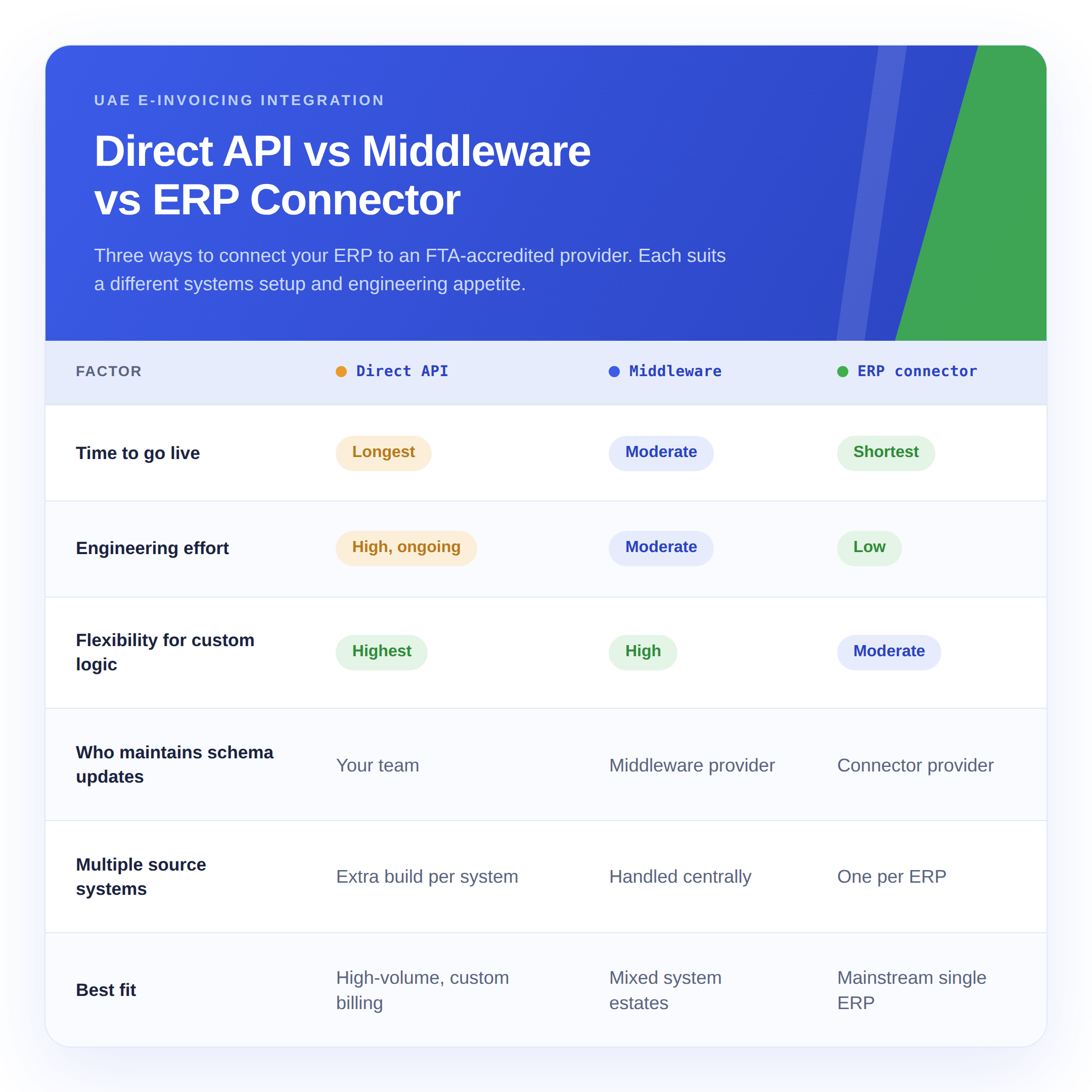
In practice, the decision usually comes down to a simple question: do you want to own the compliance engineering, or hand it off? A direct API suits teams that need deep control and have the engineers to maintain it. Middleware suits complex, multi-system estates that want flexibility without the maintenance. A prebuilt connector suits the many businesses that simply want to be compliant quickly on a mainstream ERP.
The best e-invoicing solution in UAE is not a single approach for everyone. It is the one that matches your systems and your appetite for engineering. This is where a provider that supports all three, rather than forcing one, becomes valuable, because your integration path can follow your business rather than the other way around.
Comparing the three at a glance
What the integration has to get right
Whichever path you choose, the integration is judged on the same thing: does every invoice it produces pass validation and carry the correct structured data. Three areas cause the most rejections in practice.
- Transaction classifications
Every B2B invoice must embed mandatory flags describing the nature of the transaction, including whether it involves a Free Trade Zone, falls under the Margin Scheme, or is a Deemed Supply. These are not line-item details. They change how VAT applies, and a missing flag fails the invoice.
- Legal registration identifiers
The schema demands the correct legal identifier for each party, matched to the entity type. A company is identified by its Trade License, a resident by an Emirates ID, a non-resident by a Passport, and certain entities by a Commercial Department registration. The integration has to select the right one dynamically, per transaction.
- Multi-currency handling
If an invoice is raised in a foreign currency, the XML must display both the transaction amount and its exact AED equivalent, converted at the daily exchange rate published on the FTA's portal. Not a bank rate. Not an internal average. The official figure, applied to the correct date.
A capable e-invoicing solution for UAE businesses fills every one of these correctly without a person checking each invoice. That is the real measure of a good integration.
Choosing your approach: a readiness checklist
Work through these steps to land on the right integration path and to be ready for your deadline.
- Confirm your revenue band: It sets your clock. AED 50 million or more means an ASP by 30 October 2026 and go-live on 1 January 2027.
- Audit your ERP: Establish whether it can produce structured invoice data and connect to an Accredited Service Provider natively, or whether it needs a connector or middleware.
- Clean your master data: Validate legal names, addresses and Tax Registration Numbers. Bad counterparty data is the most common cause of rejected e-invoices.
- Map your workflows: Decide how approvals, credit notes, discounts and rejections behave once invoices are structured and reported.
- Choose an accredited provider: Select only from the Ministry of Finance list, and compare on integration fit, support and price.
- Test during the pilot: Run the full flow live from 1 July 2026 with no penalty exposure. It is the cheapest way to surface problems.
Timing note: Implementation typically takes several weeks once systems and data are ready. Starting during the voluntary window, rather than close to your mandatory date, removes the risk of a rushed cutover.
How SMARTeIS handles the integration for you
SMARTeIS by Skill Quotient Technologies is the UAE's first FTA-accredited e-invoicing solution, and the first ASP to go live on the Emaratax portal. It was built so the integration layer, the hardest part of any e-invoicing project, is one less thing for your team to engineer and maintain. Where most of this guide describes the work involved in connecting your systems, SMARTeIS by Skill Quotient Technologies is designed to absorb that work for you.
Here is how a leading e-invoicing solution in UAE handles each part of the flow.
Broad ERP and POS coverage, not just the big three
SMARTeIS supports more than 150 ERP and POS systems, with over 2,500 completed integrations delivered by a dedicated team of integration engineers. Its proven connectors span SAP, Oracle, Microsoft Dynamics 365, Sage, OpenText, Infor and beyond, alongside a direct API and SFTP option for custom or in-house systems. This breadth is what lets it act as a smart compliance bridge. PINT AE formatting, validation, digital signature and FTA transmission happen without restructuring your ERP. For enterprises adopting an e-invoicing system in UAE at scale, that means a shorter path to go-live and far less internal engineering.
Automatic PINT AE mapping done correctly
The value of any best e-invoicing software in UAE lives in whether it fills the schema correctly on every invoice. SMARTeIS maps your internal data onto the PINT AE standard automatically, including the transaction classification flags, the correct legal identifiers per entity type, and the exact AED currency conversion at the FTA daily rate. These are the three areas that cause most validation failures, handled without a person checking each invoice.
End-to-end validation, transmission and reporting
Built on a decentralised Peppol-based 5-corner architecture, SMARTeIS validates each invoice in real time, with latency under 200 milliseconds, then transmits it over the Peppol network and reports the tax data to the FTA. As a fully PEPPOL e-invoicing solution in UAE, it keeps your invoices compliant and interoperable across the same network the FTA relies on. Schema and regulatory updates are maintained for you at zero additional cost, so a rule change never becomes your team's emergency.
Enterprise-grade scale and security
SMARTeIS runs on ISO 27001 and SOC 2 certified infrastructure, processes over two billion invoices a year, and stores all invoice data within the UAE to meet the Tax Procedures Law retention requirement of up to 15 years. Trusted by more than 1,000 global enterprises and recognised in Gartner Peer Insights, it is widely regarded as one of the best Peppol-ready e-invoicing software platforms in UAE for compliance-critical integrations.
A structured onboarding path
Getting live follows a clear four-stage process: a discovery phase with a product demo and tailored proposal, setup and integration including a gap assessment and compliance workshop, sandbox testing with full performance and penetration checks, and a supported go-live with a hypercare period and ongoing maintenance. Backed by a 24/7 local support team, this is what makes SMARTeIS a single, reliable e-invoicing partner in UAE for the road to 2027.
As a top e-invoicing software in UAE, SMARTeIS gives enterprises one dependable route from their existing systems to full FTA compliance. You can book a free consultation and see it in action here: https://smart-einvoicing.com/uae/
Frequently asked questions
1. Is emailing a PDF invoice enough to comply with the UAE e-invoicing mandate?
No. A compliant e-invoice is a structured PINT AE XML file exchanged through an FTA-approved Accredited Service Provider (ASP) and reported to the FTA. A PDF or scanned invoice has no compliance value once your phase goes live, which is why businesses are moving to a proper e-invoicing solution in UAE well ahead of the deadline.
2. What is the best e-invoicing software in UAE for my business?
The best e-invoicing software in UAE is the one that connects cleanly to your existing ERP, maps every PINT AE field automatically, and is backed by FTA accreditation. For businesses on SAP, Oracle or Microsoft Dynamics, a prebuilt connector like SMARTeIS by Skill Quotient Technologies removes most of the engineering work and shortens time to go-live.
3. What is PEPPOL e-invoicing in UAE, and why does it matter?
The UAE has adopted a Peppol-based model, so every compliant invoice travels over the Peppol network in the PINT AE format. Choosing a Peppol e-invoicing solution in UAE means your invoices are validated, exchanged and reported through the same standardised network the FTA relies on, which is what keeps them compliant and interoperable.
4. Do I have to build a direct API integration myself?
Not necessarily. A direct API gives the most control but the most maintenance. Many businesses instead use a prebuilt ERP connector or middleware so mapping, validation and schema updates are handled for them. The best e-invoicing system in UAE for you depends on your systems, invoice volume and internal engineering resources.
5. Which ERPs can SMARTeIS by Skill Quotient Technologies connect to?
SMARTeIS by Skill Quotient Technologies provides prebuilt connectors for SAP, Oracle and Microsoft Dynamics, plus a general API for custom or in-house systems. As a top e-invoicing software in UAE, it preconfigures the PINT AE field mapping so issuing a compliant invoice mirrors your existing billing process.
6. When is the deadline to appoint an FTA-approved Accredited Service Provider?
Businesses with annual revenue of AED 50 million or more must appoint an ASP by 30 October 2026 and go live on 1 January 2027. Smaller businesses and government entities follow on staggered dates through 2027. Always confirm your revenue band against the official Ministry of Finance guidance.
7. What happens during the voluntary pilot in July 2026?
From 1 July 2026 you can run the full electronic invoicing system in UAE live, with no penalty exposure. It is the ideal window to test your integration, validate master data, and fix issues before mandatory enforcement begins. Early adopters avoid a rushed cutover closer to their deadline.
8. How long does it take to implement an e-invoicing system in UAE?
Once your systems and master data are ready, implementation typically takes several weeks. A prebuilt ERP connector is the fastest route, while a direct API build takes longer. Starting during the pilot window rather than near your mandatory date is the safest way to deploy a leading e-invoicing solution in UAE without disruption.
9. What makes an e-invoice fail FTA validation?
Most rejections come from three areas: missing transaction classification flags (Free Trade Zone, Margin Scheme, Deemed Supply), the wrong legal identifier for the entity type, and incorrect currency conversion. A capable e-invoicing software in UAE fills all three automatically, which is what separates a reliable solution from a basic one.
10. Why choose SMARTeIS by Skill Quotient Technologies as your e-invoicing partner in UAE?
SMARTeIS by Skill Quotient Technologies is the UAE's first FTA-approved Accredited Service Provider and a leading, Peppol-ready e-invoicing solution in UAE. It combines native SAP, Oracle and Dynamics connectors with automatic PINT AE mapping and end-to-end FTA reporting, giving enterprises a single, dependable e-invoicing partner in UAE for the road to 2027.