

As the UAE accelerates its digital transformation agenda, finance leaders are stepping into a new era of compliance. By 2026–2027, three major regulatory streams will converge – Mandatory UAE e-invoicing via Peppol, Corporate Tax compliance (including transfer pricing), Domestic Minimum Top-Up Tax (DMTT) for multinational groups. Driven by the UAE Ministry of Finance and the Federal Tax Authority, this transformation reshapes how businesses manage tax, reporting, technology, and risk.
For CFOs in the UAE, this is more than regulatory alignment. It’s an opportunity to modernise finance operations, strengthen governance, and unlock real-time financial visibility.This playbook outlines what every CFO needs to know to navigate the UAE’s e-invoicing mandate confidently and strategically.
Table of Contents
- Understanding the UAE E-invoicing Mandate
- How the Peppol 5-Corner Model Works
- UAE Compliance Deadlines CFOs Cannot Miss
- Penalties for Non-Compliance
- Why CFOs Must Lead the E-invoicing Transformation
- Why CFOs are Choosing the Top-rated UAE E-invoicing Solution
- Risk Management and UAE E-invoicing Compliance Assurance
- Data Security and the UAE Personal Data Protection Law
- Audit Readiness and FTA Record Retention Requirements
- How to Choose the Best E-invoicing Partner for Your Business
- Conclusion
Understanding the UAE E-invoicing Mandate
This means:
- No more paper invoices
- No more scanned copies
- No more PDF-only billing
Invoices must follow the machine readable PINT-AE XML format, aligned with UBL 2.1 standards, and transmitted via accredited service providers connected to the Peppol network.
How the Peppol 5-Corner Model Works
The UAE adopts the international Peppol 5-corner model involving:
- Supplier ERP system
- Supplier Accredited Service Provider (ASP)
- Federal Tax Authority
- Buyer Accredited Service Provider (ASP)
- Buyer ERP system
Both AR and AP functions are impacted simultaneously. This is a full finance transformation, not just a billing upgrade.
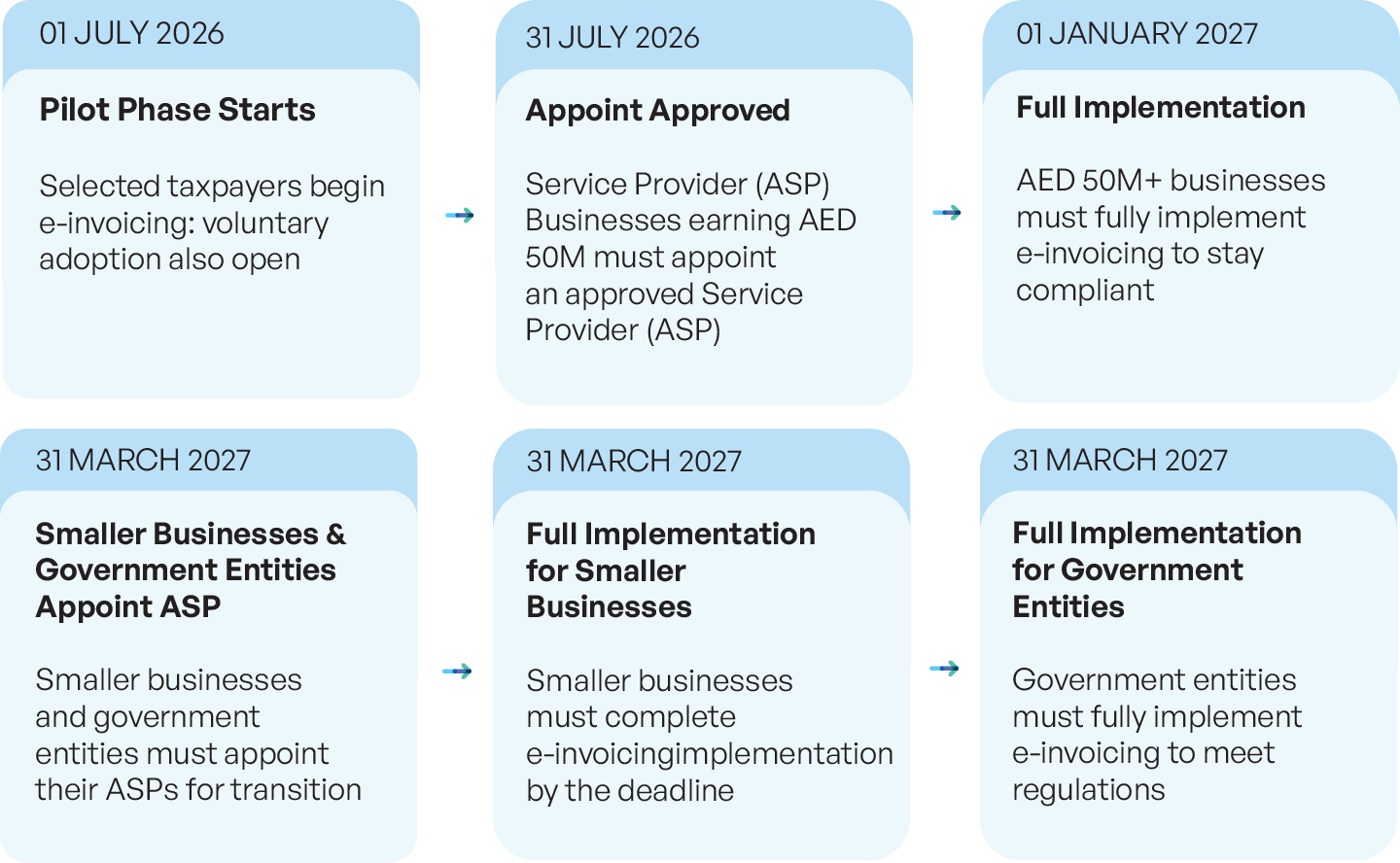
UAE Compliance Deadlines CFOs Cannot Miss
The window for preparation is narrowing. Organisations evaluating e-invoice software across the UAE must act now to avoid disruption and penalties.
Penalties for Non-Compliance
Failure to prepare for UAE’s digital compliance mandate can result in:
- Regulatory penalties
- Transaction rejections
- Supply chain disruption
- Audit complications
- Reputational damage
More importantly, delayed transformation increases long-term implementation costs and operational strain. Penalties for non-compliance are substantial and clearly defined in Cabinet Decision No. 106 of 2025.
- Failure by the Issuer to implement the e-Invoicing System or failure to appoint an ASP (AED 5,000/month)
- Failure by the Issuer to issue and transmit an e-Invoice/credit note to the Recipient (AED 100/e-invoice, max AED 5,000/month)
- Failure by the Issuer/Recipient to notify the Authority of a System Failure (AED 1,000/day)
- Failure by the Issuer/Recipient to notify the appointed ASP of changes to the data registered with the Authority(AED 1,000/day)
- Cash flow cycles
- Working capital management
- Audit readiness
- Tax accuracy and reporting
- Vendor and customer relationships
- 40-60% reduction in invoice processing time
- 70-80% reduction in data entry errors
- 5-10 day improvement in days sales outstanding (DSO)
- Percentage of invoices successfully transmitted.
- Validation error rates and average delivery times.
- Exception handling metrics and manual intervention volumes
- Average resolution times that highlight process bottlenecks
- End-to-end encryption
- ISO 27001-certified infrastructure
- Regular third-party security audits
- UAE data residency documentation
- Defined incident response procedures
- Disaster recovery and business continuity plans
- Comprehensive documentation of all tax positions and judgments
- Accessible transfer pricing master and local files
- A documented tax governance framework
- Full audit trails linking each e-invoice to its underlying transaction
- Pre-approved compliance capability
- Peppol-ready architecture
- Seamless ERP integration
- Reconciliation dashboards
- Local support team
- Ongoing regulatory updates
Why CFOs Must Lead the E-invoicing Transformation
Digital compliance is not just an IT responsibility. It directly impacts:
Finance leaders must treat this as a strategic technology transformation requiring significant investment in both systems and organisational capabilities. The statistics are sobering: approximately 70% of digital transformations, including ERP implementations, fail due to insufficient planning, poor change management, or inadequate stakeholder alignment. Success requires a disciplined, phased approach beginning with comprehensive assessment of current capabilities.
Why CFOs are Choosing the Top-rated UAE E-invoicing Solution
Forward-thinking CFOs recognise that investing in e-invoicing software generates returns far beyond regulatory necessity. Organisations implementing a top-rated UAE e-invoicing system typically achieve:
Because invoices are transmitted in structured digital format via Peppol networks, they are delivered directly into customers’ ERP systems. This enables straight-through processing, faster approvals, and accelerated payment cycles. The result? Improved cash flow, reduced administrative burden, and stronger financial control.
Risk Management and UAE E-invoicing Compliance Assurance
Digital compliance introduces new operational risks. CFOs must implement real-time monitoring to maintain continuous FTA e-invoicing compliance.
Key compliance dashboards should track:
Proactive monitoring prevents compliance failures before they occur.
Data Security and the UAE Personal Data Protection Law
Data protection is critical in a digital invoicing ecosystem. The UAE’s Personal Data Protection Law (PDPL) imposes strict requirements on how invoice data is transmitted, processed, and stored. CFOs must ensure their e-invoicing provider meets enterprise-grade security standards.
Because invoice data often contains sensitive commercial and financial information, selecting a secure Accredited Service Provider (ASP) is a strategic risk decision, not just a technical one.
Audit Readiness and FTA Record Retention Requirements
Under UAE tax regulations, businesses must retain e-invoice records for a minimum of five to fifteen years. With the Federal Tax Authority leveraging increasingly sophisticated data analytics, audit preparedness is more important than ever. To maintain audit readiness, CFOs should ensure:
Proactive governance reduces audit risk and ensures long-term UAE e-invoicing compliance.
How to Choose the Best E-invoicing Partner for Your Business
Selecting the right e-invoicing partner represents a critical decision that will impact operations for years to come. A strong solution should offer:
For enterprises operating in the UAE, selecting a pre-approved solution aligned with the UAE Ministry of Finance framework like SMARTeIS by Skill Quotient Technologies reduces implementation risk and ensures long-term compliance stability.
Conclusion
The UAE’s digital compliance mandate marks a defining moment for finance leaders. The question is not whether organisations must comply. It’s how strategically they choose to implement. The role of CFOs is to establish governance structures ensuring appropriate executive attention and resource allocation, conduct rigorous assessments of current capabilities and gaps, select technology partners based on comprehensive evaluation criteria, implement using phased approaches that manage risk and change fatigue, and establish monitoring frameworks ensuring ongoing compliance.
The organisations that approach this transformation strategically rather than tactically will not only ensure regulatory alignment but also unlock measurable business value from digital transformation.
Get started with the UAE’s Top-rated E-Invoicing Software today. Book your free demo!
Talk to a UAE e-invoicing expert
Get clarity on timelines, PEPPOL requirements, and implementation approach tailored to your business.